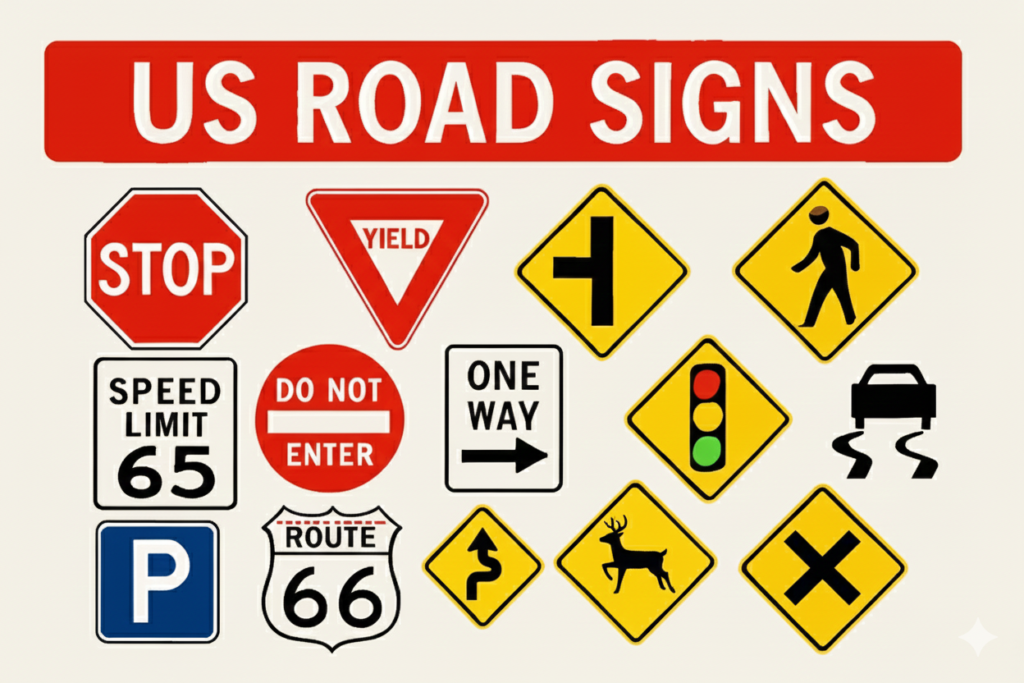
Your Guaranteed Path to Mastering All US Traffic Signs and Passing Your Permit Exam on the First Try
Studying for the DMV knowledge test can often feel overwhelming. Between dense state handbooks and confusing online resources, preparing to take the written exam often feels “scary, boring, and confusing”—a daunting task for any new driver.
This comprehensive guide is designed to cut through the noise, providing you with the exact knowledge you need to ace your permit or license renewal test. We break down the official standards for US traffic signs, giving you the critical definitions and memory tricks used by driving experts.
While this page provides the definitive guide to every sign meaning, the real key to passing is interactive practice. Use this guide to learn the rules, then download our top-rated Android app for dynamic, adaptive practice tests that guarantee success.

Introduction
Understanding US road signs is fundamental for anyone preparing for the DMV test, learning to drive in the USA, or simply aiming to become a safer, more confident driver. Road signs are the language of American roads: they regulate traffic, warn of hazards, provide guidance, and ensure the safety of all road users. For new drivers, international visitors, and even seasoned motorists, mastering the meanings and categories of US road signs is not just a legal requirement but a practical necessity for navigating the diverse and sometimes complex American road system.
This comprehensive guide is designed to serve as the definitive resource on US road signs. It covers the main categories, their meanings, color and shape codes, and their importance for passing the DMV test and driving safely in the USA. The content is optimized for search engines with strategic use of keywords such as US road signs, DMV test, driving in the USA, road sign meanings, and traffic signs practice. Throughout, you’ll find actionable insights, practical tips, and a clear call to action to download the US Road Signs Test app for interactive learning and practice.
Why Mastering US Road Signs Matters
Essential for DMV Test Success
A significant portion of the DMV written test focuses on road signs and their meanings. In most states, 30–40% of permit test questions are about recognizing and interpreting traffic signs. Failing to understand these signs is one of the most common reasons new drivers do not pass the test on their first attempt. Mastery of road signs is therefore a direct path to DMV test success.
Critical for Safe and Confident Driving
Road signs are not just exam content—they are real-world tools for safe driving. They communicate rules, warn of hazards, and guide drivers through unfamiliar territory. For international visitors or those driving in the USA for the first time, understanding these signs is crucial for adapting to local traffic laws and customs.
Universal Language for All Drivers
The US road sign system is standardized by the Manual on Uniform Traffic Control Devices (MUTCD), ensuring consistency across states. This standardization means that once you learn the core categories and meanings, you can drive confidently anywhere in the country.
US Road Signs: Categories, Colors, and Shapes
Overview of Main Categories
US road signs are organized into several main categories, each serving a distinct purpose:
| Category | Purpose | Typical Color(s) | Typical Shape(s) | Examples |
| Regulatory Signs | Indicate laws and regulations | Red, White, Black | Rectangle, Octagon | Stop, Yield, Speed Limit |
| Warning Signs | Alert to hazards or changes in road conditions | Yellow, Orange | Diamond, Pentagon | Curve Ahead, School Zone |
| Guide Signs | Provide directions and information | Green, Blue, Brown | Rectangle | Exit, Hospital, Park |
| Construction/Work Zone | Warn of construction or maintenance zones | Orange | Diamond, Rectangle | Road Work Ahead, Detour |
| Service Signs | Indicate nearby services | Blue | Rectangle, Square | Gas, Food, Lodging |
| Recreational Signs | Point to parks and points of interest | Brown | Rectangle, Trapezoid | Campground, Historic Site |
| Emergency/Incident | Warn of emergencies or incidents | Fluorescent Pink | Rectangle, Diamond | Incident Ahead |
| School Signs | Indicate school zones and crossings | Fluorescent Yellow-Green | Pentagon | School Zone, School Crossing |
Each category is distinguished by specific colors and shapes, which help drivers quickly interpret their meaning even before reading the text or symbols.
Regulatory Signs

Regulatory signs communicate the rules of the road—what you must or must not do. They are enforceable by law, and failure to obey them can result in fines or penalties.
Regulatory signs communicate the rules of the road—what you must or must not do. They are enforceable by law, and failure to obey them can result in fines or penalties.
- Colors: Red (prohibitive), White (background), Black (text or symbols)
- Shapes: Rectangle (most), Octagon (Stop), Triangle (Yield)
- Examples: Stop, Yield, Do Not Enter, Speed Limit, No U-Turn, One Way
Key Regulatory Signs:
- Stop Sign (Octagon, Red): Come to a complete stop at the marked line or before entering the intersection.
- Yield Sign (Triangle, Red/White): Slow down and give right-of-way to other vehicles or pedestrians.
- Speed Limit (Rectangle, White/Black): Indicates the maximum (and sometimes minimum) legal speed.
- Do Not Enter (Rectangle, Red/White): Prohibits entry to a roadway.
- No Parking (Rectangle, Red/White): Parking is not allowed in the designated area.
Why They Matter: Regulatory signs are the backbone of traffic law enforcement. Recognizing them instantly is essential for both passing the DMV test and avoiding violations on the road.
Warning Signs
Warning signs alert drivers to potential hazards, changes in road conditions, or upcoming situations that require caution.
- Colors: Yellow (general warnings), Orange (construction), Fluorescent Yellow-Green (school zones, pedestrian crossings)
- Shapes: Diamond (most), Pentagon (school), Circle (railroad), Pennant (no passing)
- Examples: Curve Ahead, Merge, Pedestrian Crossing, School Zone, Slippery When Wet
Key Warning Signs:
- Curve Ahead (Diamond, Yellow): Prepare to slow down and navigate a curve.
- Pedestrian Crossing (Diamond, Yellow or Fluorescent Yellow-Green): Watch for pedestrians crossing the road.
- School Zone (Pentagon, Fluorescent Yellow-Green): Reduce speed and watch for children.
- Railroad Crossing (Circle, Yellow/Black): Indicates a railroad crossing ahead.
- No Passing Zone (Pennant, Yellow): Marks the beginning of a no-passing area.
Why They Matter: Warning signs give drivers advance notice to adjust speed, change lanes, or prepare for unusual conditions, reducing the risk of accidents.
Guide Signs
Guide signs provide navigational information, helping drivers find their way to destinations, services, and points of interest.
- Colors: Green (directions), Blue (services), Brown (recreation)
- Shapes: Rectangle (most), Trapezoid (recreation)
- Examples: Exit Signs, Interstate Markers, Hospital, Gas, Campground
Key Guide Signs:
- Exit Signs (Rectangle, Green/White): Indicate upcoming highway exits.
- Interstate Markers (Shield, Red/White/Blue): Identify interstate highways.
- Service Signs (Rectangle, Blue/White): Direct to gas stations, food, hospitals, rest areas.
- Recreational Signs (Rectangle/Trapezoid, Brown/White): Point to parks, campgrounds, historic sites.
Why They Matter: Guide signs are essential for trip planning, emergency stops, and finding amenities, especially for drivers unfamiliar with the area or international visitors.
Construction and Work Zone Signs
Construction signs warn of temporary changes due to roadwork, maintenance, or emergencies.
- Color: Orange (with black text or symbols)
- Shape: Diamond or Rectangle
- Examples: Road Work Ahead, Detour, Lane Closed, Flagger Ahead
Why They Matter: Work zones often have reduced speed limits and altered traffic patterns. Fines for violations in these areas are typically doubled, and extra caution is required.
Service and Recreational Signs
- Service Signs (Blue): Indicate locations of essential services such as hospitals, gas stations, food, and lodging.
- Recreational Signs (Brown): Point to parks, campgrounds, scenic routes, and historic sites.
Why They Matter: These signs help drivers plan stops and enjoy their journey, especially on long trips or in unfamiliar regions.
Emergency and Incident Signs
- Color: Fluorescent Pink
- Purpose: Warn of unplanned incidents such as accidents, natural disasters, or emergency detours.
Why They Matter: These signs are relatively new and are crucial for alerting drivers to unexpected hazards or changes in traffic flow.
School Signs
- Color: Fluorescent Yellow-Green
- Shape: Pentagon
- Purpose: Indicate school zones, crossings, and bus stops.
Why They Matter: School signs require drivers to slow down and be extra vigilant for children, especially during school hours.
Color and Shape Codes: The Visual Language of US Road Signs
Understanding the color and shape codes of US road signs enables drivers to interpret their meaning at a glance, even before reading the text or symbols.
Color Codes
- Red: Stop, yield, prohibitions (e.g., Stop, Yield, Do Not Enter)
- White: Regulatory information (e.g., Speed Limit, No Parking)
- Black: Used for text or symbols on white regulatory signs
- Yellow: General warnings (e.g., Curve Ahead, Merge)
- Orange: Construction and maintenance warnings
- Green: Directional guidance (e.g., Exit, Mile Marker)
- Blue: Services and amenities (e.g., Hospital, Gas)
- Brown: Recreational and cultural interest (e.g., Park, Historic Site)
- Fluorescent Yellow-Green: School zones, pedestrian and bicycle crossings
- Fluorescent Pink: Emergency or incident management
Shape Codes
- Octagon: Stop (unique to stop signs)
- Triangle (point down): Yield
- Vertical Rectangle: Regulatory
- Horizontal Rectangle: Guide
- Diamond: Warning
- Pentagon: School zone or crossing
- Pennant: No passing zone (always on the left side of the road)
- Circle: Railroad crossing ahead
- Crossbuck (X): Railroad crossing at the tracks
- Trapezoid: Recreational areas (in some states)
| Shape | Typical Use | Example |
| Octagon | Stop | Stop Sign |
| Triangle | Yield | Yield Sign |
| Diamond | Warning | Curve Ahead |
| Rectangle | Regulatory/Guide | Speed Limit, Exit |
| Pentagon | School | School Zone |
| Pennant | No Passing Zone | No Passing Zone |
| Circle | Railroad Crossing | Railroad Crossing |
| Crossbuck | Railroad Crossing | At the tracks |
| Trapezoid | Recreation (select states) | Park Entrance |
Why This Matters: Recognizing the color and shape of a sign allows for faster, safer decision-making, especially in high-speed or complex driving environments.
Pavement Markings: The Road’s Painted Signs
In addition to posted signs, pavement markings play a crucial role in regulating and guiding traffic.
- Yellow Lines: Separate traffic moving in opposite directions; also used for two-way left-turn lanes and reversible lanes.
- White Lines: Separate lanes moving in the same direction; mark the right edge of the roadway.
- Solid Lines: Discourage or prohibit crossing.
- Broken Lines: Allow passing or lane changes when safe.
- Double Lines: Indicate maximum or special restrictions.
- Arrows: Indicate permitted lane movements (e.g., turn only, straight only).
- Stop Lines: Show where to stop at intersections or crosswalks.
- Yield Lines: Indicate where to yield.
- Bike Lane Markings: Designate lanes for bicycles.
Why This Matters: Pavement markings reinforce the rules set by road signs and signals, ensuring safe and organized traffic flow.
Special Rules and Local Variations
While the MUTCD standardizes most US road signs, some state-specific signs and rules exist. For example, certain states may use unique signs for local regulations, toll roads, or scenic byways. Always review your state’s driver handbook for any local variations.
International Drivers: Be aware that US road signs use imperial units (miles, mph, gallons) and English-language abbreviations. Familiarize yourself with common terms and conversions before driving in the USA.
Tips for Mastering US Road Signs for the DMV Test
- Use Shape and Color Memory Aids: Associate shapes and colors with their meanings for quick recall.
- Practice with Flashcards: Focus on signs you find most confusing.
- Take Practice Tests: Simulate the DMV test environment to build confidence.
- Drive with Awareness: Observe and interpret signs while riding as a passenger.
- Review State-Specific Signs: Some signs may be unique to your state.
The “STOP YIELD GO” Method: Remember the hierarchy—red means STOP (highest priority), yellow means YIELD/proceed with caution, green means GO/information only.
Interactive Learning: Why Practice Makes Perfect
Traditional study methods are valuable, but interactive practice is proven to boost retention and test performance. Engaging with real-world scenarios, quizzes, and visual drills helps you recognize signs quickly and respond appropriately under pressure.
Benefits of Interactive Practice:
- Faster Recognition: Visual drills improve your ability to identify signs instantly.
- Realistic Scenarios: Simulations mimic actual driving situations, preparing you for both the test and the road.
- Immediate Feedback: Practice tests and quizzes provide instant correction and reinforcement.
Download the US Road Signs Test App for Interactive Practice
Ready to take your learning to the next level? The US Road Signs Test app offers:
- Comprehensive Sign Database: Covers all major categories and state-specific variations.
- Practice Quizzes: DMV-style questions to test your knowledge.
- Visual Recognition Drills: Sharpen your ability to identify signs quickly.
- Progress Tracking: Monitor your improvement and focus on weak areas.
- User-Friendly Interface: Designed for both beginners and experienced drivers.
Don’t just study—practice, master, and pass your DMV test with confidence!